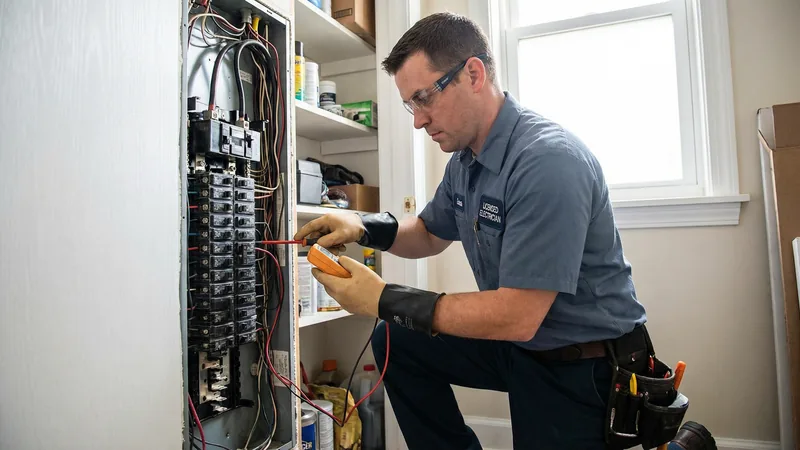
Electricians occupy a strange middle ground in local PPC, the trade covers everything from a $150 outlet repair to a $15,000 panel upgrade or full rewire, and those jobs come from completely different search behaviors. Dominating local search as an electrician isn't about picking Google Ads or Local Services Ads; it's about running both, structured correctly, so you're covering every stage of a homeowner's decision.
Why Electricians Need Both LSA and Search Ads
Google Local Services Ads place a Google-screened badge and your reviews above the standard search results, with pay-per-lead pricing instead of pay-per-click. For a homeowner with a tripped breaker or a sparking outlet, that badge is often the single deciding factor between two nearly identical local listings. But LSA has real limits: you can't control ad copy, you can't build procedure-specific landing pages, and lead quality varies since Google's matching algorithm: not you - decides which leads reach you.
Standard Search campaigns fill that gap. You control the keyword list, the messaging, the landing page, and the bid strategy down to the job type. Running both means you appear in the LSA slot above the map pack and in the paid search results below it, effectively occupying two positions for the same search, which is a meaningful share-of-voice advantage over competitors running only one.
Setting Up Local Services Ads Correctly
Background checks, license verification, and insurance documentation are required before Google approves your LSA profile, and the review process can take 1-3 weeks: start this well before you need leads flowing. Once live, your ranking within LSA is driven heavily by review volume, review recency, and responsiveness (how quickly you answer calls and messages). Electricians who treat LSA as "set it and forget it" consistently get outranked by competitors who actively request reviews after every completed job and respond to leads within minutes rather than hours.
Search Campaign Structure by Job Type
I split electrician Search accounts into distinct campaigns rather than one blended "electrical services" campaign:
- Emergency/Repair: no power, tripped breaker, sparking outlet, exposed wiring. Highest urgency, converts same-day, tolerates higher CPCs.
- Panel Upgrades & Rewiring: larger jobs, longer research phase, benefits from financing messaging and remarketing.
- EV Charger Installation, a fast-growing category with its own search behavior and often less competition than core electrical terms.
- Lighting & Fixture Installation - lower-ticket, higher-volume, good for filling schedule gaps.
This mirrors the same structural principle we recommend across trades in our complete PPC guide for electricians: segmenting by job type, not just by service category, is what lets you bid and message appropriately for each.
Keyword Strategy and the Negative List You Actually Need
Electrical keywords attract a surprising amount of irrelevant traffic: DIY searches ("how to wire a switch myself"), job-seeker searches ("electrician apprentice jobs near me"), and product-only searches with no service intent ("Square D panel price"). A strong negative keyword list built before launch, not after a wasted-spend report - saves real budget in month one.
| Job Type | Typical CPC Range | Notes |
|---|---|---|
| Emergency electrician / no power | $5-$15 | Highest urgency, converts same day |
| Panel upgrade / rewiring | $7-$20 | Longer consideration, high deal value |
| EV charger installation | $5-$12 | Growing category, often less competitive |
| General/handyman electrical | $3-$8 | Higher volume, lower deal value |
Budgets, CPCs, and What Results to Expect
Most independent electricians and small crews run effectively on $1,500-$3,000/month combined across LSA and Search, scaling toward $5,000+/month once they're adding a second or third truck. At a blended CPC in the $5-$15 range and a healthy landing-page conversion rate, that budget typically produces enough qualified leads to keep one to two crews consistently booked, though exact volume depends heavily on local competition and how tightly negatives are managed.
Landing Pages That Convert Electrical Leads
Emergency traffic needs a phone number above the fold and near-zero form friction, no one with a sparking outlet wants to fill out an eight-field quote request. Panel upgrade and rewiring traffic, by contrast, converts better with a short form that captures enough project detail (home age, panel amperage, square footage) to let you quote accurately before the first call, which shortens your sales cycle and filters out low-intent tire-kickers.
Seasonal Demand Spikes Worth Planning Around
Electrical demand isn't flat year-round. Storm season drives spikes in emergency and generator-hookup searches, summer drives AC-circuit and panel-capacity searches as homeowners add cooling load, and EV charger installation searches climb steadily each year as EV adoption grows. Reviewing Google Trends data for your specific service area before setting seasonal budgets prevents both under- and over-spending relative to actual demand, the same seasonal planning logic we cover in spring marketing campaigns for lead generation applies directly to electrical trades.
Mistakes That Quietly Drain Electrician Ad Budgets
- Running LSA without responding fast. Lead response time directly affects your LSA ranking and win rate, slow responses cost you both.
- One blended campaign for every job type. Emergency and panel-upgrade searchers need different bids, ads, and landing pages entirely.
- No call tracking. Electrical converts heavily by phone; see our call tracking setup guide to close that visibility gap.
- Ignoring service-area targeting precision. Bidding on an entire metro when you realistically serve a 15-mile radius wastes spend on jobs you'll decline anyway.
Electricians who run LSA and Search together, segment by job type, and manage their negative list actively tend to build the most predictable, scalable lead pipeline in this trade: it's a more deliberate approach than most competitors take, which is exactly why it works.
Writing Ad Copy for Each Job-Type Campaign
Once campaigns are split by job type, the ad copy should stop sounding interchangeable. A few examples of what actually performs:
- Emergency/Repair: "No Power? Licensed Electrician Available Now," "24/7 Emergency Electrical Repair," "Fast Response, Upfront Pricing." Urgency and availability beat brand messaging every time in this tier.
- Panel Upgrades: "Upgrade Your Panel Before It Fails," "Financing Available on Panel Upgrades," "Free Panel Inspection & Quote." This is a considered purchase: give the searcher a reason to act now (safety, financing) rather than just describing the service.
- EV Charger Installation: "Certified EV Charger Installation," "Home EV Charging Setup in Under a Day," "Compatible With All Major EV Brands." Reassurance on compatibility and speed of install addresses the two biggest hesitations for this newer search category.
Rotating two or three headline variations per ad group and letting a few weeks of click data determine the winner beats guessing which angle will resonate, the data settles it faster than instinct usually can.
Google Business Profile: The Free Half of Local Domination
Paid campaigns work harder when your Google Business Profile is fully built out alongside them, complete service list, updated hours, regularly posted project photos, and an active review request habit after every job. A strong, review-rich profile doesn't just help organic map pack rankings; it directly supports your Local Services Ads ranking too, since review volume and rating feed into both systems. Electricians who treat their profile as a "set once" asset consistently lose ground to competitors who update it weekly and request a review after every single completed job, no exceptions.
Licensing, Insurance, and Trust Signals That Win Ties
Electrical work carries real safety stakes, and homeowners comparing two similarly priced, similarly reviewed electricians will often default to whichever one displays license number, insurance coverage, and years in business most clearly on their landing page. This is a low-cost, high-leverage addition: a simple "Licensed & Insured: License #XXXXX" line near your call-to-action button consistently nudges conversion rate upward in a category where the cost of hiring an unqualified provider (a fire hazard, a failed inspection) is genuinely serious in a homeowner's mind, even if they don't articulate that concern explicitly.
Tracking Close Rate, Not Just Lead Volume
A campaign generating 30 leads a month at $40 each looks worse on paper than one generating 15 leads at $60 each, until you factor in that the cheaper leads close into paying jobs at half the rate. Electricians should track close rate by campaign and job type, not just cost per lead, since panel upgrade and EV charger leads often close at a different rate than emergency repair leads despite superficially similar-looking cost metrics. Feeding actual job-closed data back to whoever manages the account, even informally through a monthly spreadsheet, sharpens every future budget decision considerably more than lead volume alone ever could.
Residential vs. Commercial Electrical: A Different Game Entirely
Electricians who serve both residential homeowners and commercial or industrial clients should treat these as fundamentally separate campaigns rather than folding commercial keywords into a residential-focused account. Commercial electrical searches ("commercial electrician for office buildout," "industrial panel installation") involve a completely different buying process: often a facilities manager or general contractor evaluating multiple bids, with a much longer sales cycle and a request-for-quote process rather than an immediate booking decision. The search volume for commercial keywords is typically much lower than residential terms in most metros, but the average job value is often significantly higher, which changes the economics of what counts as an acceptable cost per lead.
Landing pages for commercial electrical work should look and read differently too, case studies from similar commercial projects, information about bonding and liability insurance at commercial-appropriate coverage levels, and a clear process for submitting a bid request rather than a simple "call now" button aimed at a homeowner with an immediate problem. Electricians who run a single blended campaign covering both segments often find their commercial-facing ad copy reads as underwhelming to a facilities manager evaluating vendors, while their residential ad copy feels overly formal to a homeowner who just wants someone to fix an outlet quickly. Splitting the two, even if commercial work represents a smaller share of overall volume, lets each message land correctly with its intended audience.
Whichever segments you serve, the core discipline stays the same: match campaign structure to actual job-type economics, keep your Google Business Profile and review pipeline actively maintained, and measure success by close rate and job value rather than lead volume alone. That combination is what consistently separates electricians who scale predictably through paid search from those who churn budget chasing cheap clicks that never turn into booked jobs.