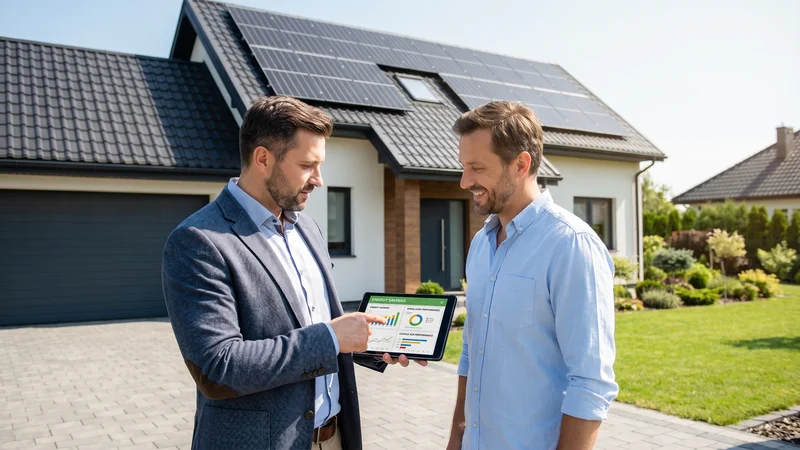
Solar sits among the highest-consideration purchases in local PPC, a single installation often represents a five-figure investment, and the sales cycle regularly spans several weeks of research, quoting, and financing decisions before a homeowner signs a contract. That combination of high ticket size and long consideration window means the cost of a poorly qualified lead is much higher here than in almost any other home-service category, and campaign structure needs to reflect that from day one.
Why Solar Is One of the Highest-Stakes Local PPC Categories
A solar sales team following up on unqualified leads: renters, homeowners with shaded or structurally unsuitable roofs, or people simply price-shopping out of curiosity: burns through both ad budget and sales capacity without a proportional return. Because deal sizes are large, even a modest improvement in lead qualification rate translates into a meaningful CAC reduction, which is why qualification logic deserves as much attention as the media buy itself.
Qualifying for Homeownership and Roof Suitability Up Front
The single highest-leverage change I make in solar accounts is adding qualification questions directly to the lead form or a short pre-quote quiz: homeownership status, roof age and material, average monthly electric bill, and shading conditions. This does reduce raw lead volume, but it dramatically improves the percentage of leads that are actually viable candidates for a system: which is a far better trade for a sales team's time than chasing a larger volume of unqualified inquiries.
Incentive and Rebate Messaging Drives Clicks - Verify It Carefully
Federal and regional solar incentives, tax credits, and utility rebate programs are powerful click drivers in ad copy, but they change frequently and vary significantly by jurisdiction. Ad copy that references outdated or inapplicable incentive figures creates a credibility problem the moment a homeowner talks to a sales rep and hears different numbers, verify incentive messaging against current program rules before every campaign refresh, not just at launch.
Keyword Tiers From Research to Ready-to-Quote
| Keyword Tier | Search Behavior | Landing Page Goal |
|---|---|---|
| Educational/research ("how does solar work," "is solar worth it") | Early research, comparing feasibility | Savings calculator, educational content, soft CTA |
| Cost/comparison ("solar panel cost," "solar company reviews") | Actively comparing providers and pricing | Transparent pricing ranges, financing options, reviews |
| Ready-to-quote ("solar installation quote," "solar companies near me") | Ready to engage a sales conversation | Direct quote request with qualification questions |
Landing Pages: Savings Calculators Over Generic Contact Forms
A solar savings calculator: estimating potential monthly savings based on address, current electric bill, and roof orientation: consistently outperforms a plain "request a quote" form because it gives the homeowner something valuable and personalized before asking for a sales conversation. It also functions as a natural qualification step, since the inputs required (address, utility bill amount) surface homeownership and usage data that helps the sales team prioritize follow-up.
Why Lead Quality Matters More Than Volume in Solar
Given typical solar deal sizes, a company converting 15 well-qualified leads a month into 3 signed installations is in a dramatically better position than one converting 40 poorly-qualified leads into the same 3 installations: the second scenario just spent far more on sales follow-up to reach the same outcome. Track cost per signed installation, not cost per lead, as the metric that actually determines whether a campaign is working. This is the same principle covered more broadly in our guide to optimizing high cost per lead, where the fix is often qualification, not a lower CPC.
Nurturing a Multi-Week Sales Cycle
Because the decision window for solar frequently spans several weeks: homeowners are comparing quotes, researching financing, and sometimes waiting on a roof inspection: remarketing and email nurture between the initial lead and the closed sale matter more here than in shorter-cycle local services. A lead that doesn't close on the first sales call is not necessarily a dead lead; consistent, non-pushy follow-up over several weeks recovers a meaningful share of eventual signed deals that would otherwise be written off too early.
Mistakes That Waste Solar Ad Budget
- No qualification questions on the lead form. Renters and shaded-roof homeowners consume sales capacity without ever being viable candidates.
- Outdated incentive messaging. Referencing expired or inaccurate rebate figures damages trust the moment a sales rep corrects it.
- Judging campaigns on cost per lead alone. Cost per signed installation is the metric that actually reflects profitability.
- Giving up on leads after one call. A multi-week sales cycle needs multi-week nurture, not a single follow-up attempt.
Solar rewards disciplined qualification more than almost any other home-service category: the ticket size is simply too large, and the sales cycle too long, to treat every click the same way a lower-consideration local service might. Build qualification into the lead form itself, verify incentive claims regularly, and measure success against signed installations rather than raw lead count.
Financing Options as a Core Part of the Ad Message
Given the ticket size involved, financing options: solar loans, leases, or power purchase agreements: are often the single biggest factor determining whether a homeowner moves forward. Ad copy and landing pages that lead with "no money down" or specific monthly payment framing, rather than the sticker price of a full cash purchase, resonate with a much wider share of the addressable market, since most homeowners buying solar are financing the purchase rather than paying cash upfront. Making the financing conversation part of the ad message itself, not something reserved for the sales call, pre-qualifies interest more efficiently.
Trust Signals That Matter in a Category With a Reputation Problem
Solar has faced real reputation challenges in some markets due to aggressive door-to-door sales tactics and a handful of high-profile companies that oversold savings estimates. Landing pages that lead with manufacturer certifications, local installation crews (rather than a national call center), specific warranty terms, and genuine customer testimonials with names and locations attached build credibility faster than generic marketing claims in this particular category. A company willing to show its actual local presence and track record differentiates meaningfully from the perception of fly-by-night solar sales operations that has made some homeowners cautious.
Why Address-Level Data Beats Broad Demographic Targeting
Solar suitability depends heavily on factors Google Ads can't target directly: roof orientation, shading from trees or neighboring structures, and roof age relative to panel warranty periods. Rather than relying purely on demographic or income-based audience targeting, the savings calculator described earlier doubles as an implicit qualification tool by collecting address data early, which lets a sales team quickly cross-reference satellite imagery or existing solar-suitability databases before investing time in a site visit. This upfront filtering step, built into the lead capture process itself, is more predictive of actual conversion than any demographic targeting layer available within the ad platform.
A Follow-Up Cadence That Matches the Real Decision Timeline
Given the multi-week decision window typical of solar purchases, a follow-up cadence of a single call attempt within 24 hours, then giving up if unanswered, discards a large share of viable leads who simply weren't ready to talk on day one. A structured cadence: call within the hour, a second attempt the next day, an email with the savings estimate a few days later, and a check-in call roughly two weeks out: mirrors how homeowners actually make this decision and recovers meaningfully more signed installations than a single-touch follow-up approach that many sales teams default to under time pressure.
Battery Storage: A Growing Add-On Worth Its Own Messaging
Home battery storage has become an increasingly common add-on to solar installations, driven by growing interest in backup power during outages and, in some markets, changing utility net-metering policies that make storing self-generated power more valuable than exporting it to the grid. Search interest in "solar battery backup" and similar terms has grown steadily, and running a dedicated campaign or ad group around battery storage: rather than folding it as a minor mention within a general solar campaign, captures a segment of homeowners whose primary motivation is backup power resilience rather than pure cost savings, a meaningfully different angle that deserves its own ad copy.
This segment often skews toward homeowners who've experienced a recent outage or live in an area with grid reliability concerns, which makes storm and outage-related messaging ("keep the lights on during the next outage") a more resonant hook than the savings-calculator framing that works well for cost-motivated solar shoppers. Treating battery storage as a distinct product with its own buyer motivation, rather than an upsell mentioned in passing on a general solar landing page, captures a growing and increasingly valuable segment of this market.
Commercial and Agricultural Solar: A Separate Buyer Entirely
Solar installers serving both residential homeowners and commercial or agricultural clients (warehouses, farms, manufacturing facilities) should run these as completely separate campaigns given how different the buyer, sales cycle, and financial analysis look. Commercial and agricultural solar decisions are typically evaluated on depreciation schedules, commercial financing structures, and business tax incentives rather than the household-savings framing that resonates with residential homeowners, and the decision-maker is often a business owner or facilities manager working with an accountant rather than a homeowner comparing monthly bill savings. Keyword volume in this segment is far lower than residential, but individual project sizes are often many multiples larger, making even a small, well-targeted commercial campaign worth running alongside a much larger residential effort for installers equipped to service both segments.
Frequently Asked Questions
Related reading: Real Estate Lead Generation With Google Ads, CRM Integration with Google Ads: Closing the Lead Loop and Google Ads for Roofing Companies: Lead Generation.