Local Services Ads (LSA) and traditional Google Search Ads both show up at the very top of local search results, and to a searcher they can look similar at a glance. Under the hood, though, they run on completely different mechanics: different cost models, different qualification requirements, and different lead quality profiles. Choosing between them, or deciding how to split budget across both, requires actually understanding those differences rather than treating them as two flavors of the same thing.
How Local Services Ads Work
LSA is Google's pay-per-lead advertising product, available primarily to local service businesses (plumbers, electricians, HVAC companies, lawyers, and a growing list of other categories). Instead of paying for clicks, you pay only when a prospective customer actually contacts you through the platform: a phone call or a message, and that lead meets Google's criteria for a billable lead.
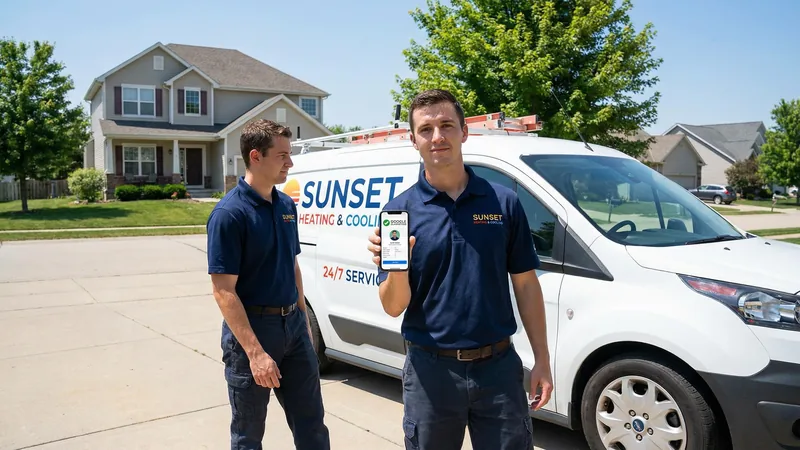
Businesses running LSA display with the "Google Guaranteed" or "Google Screened" badge (depending on industry), which requires passing a background check and, for the Guarantee program, carries a service satisfaction backing from Google itself up to a certain dollar amount. This badge is a genuine trust signal that traditional search ads simply can't replicate.
LSA listings are ranked and matched using a combination of proximity, review rating and volume, responsiveness (how quickly you respond to leads), and your bid, but the exact weighting isn't fully transparent to advertisers the way Search Ads auction mechanics are. This means two businesses with similar profiles can see meaningfully different lead volumes for reasons that aren't always obvious from the LSA dashboard alone, which is part of why disciplined review generation and fast response times matter more here than they might first appear to.
How Traditional Search Ads Work
Standard Google Search Ads run on a pay-per-click auction model: you bid on keywords, and you pay whenever someone clicks your ad, regardless of whether that click ultimately turns into a lead. This gives you far more control: you choose your keywords, write your own ad copy, control your landing page experience, and can layer in extensions, sitelinks, and detailed audience and bidding strategies that LSA simply doesn't expose to advertisers.
The trade-off is that you're paying for clicks whether or not they convert, which puts more of the performance burden on your landing page, offer, and follow-up process rather than on Google's own lead-qualification layer. That said, this control cuts both ways: a well-run Search Ads account with tight ad groups, strong Quality Scores, and a fast-converting landing page can often produce a lower true cost-per-booked-job than LSA, precisely because you have the tools to fix weak points that LSA simply doesn't expose for you to touch.
Cost Model Differences: Per-Lead vs Per-Click
| Factor | Local Services Ads | Search Ads |
|---|---|---|
| What you pay for | Qualified leads (calls/messages) only | Every click, converting or not |
| Cost predictability | More predictable cost-per-lead by design | Cost-per-lead depends heavily on landing page and offer strength |
| Control over creative/targeting | Minimal - mostly automated by Google | Full control over keywords, copy, landing pages, bidding |
| Dispute process for bad leads | Built-in dispute system for invalid leads | No equivalent - every click is paid regardless of quality |
This is one of the most underrated advantages of LSA: if a "lead" is clearly a wrong number, spam, or a job entirely outside your service area, you can dispute it and, if approved, get credited back. Traditional Search Ads have no equivalent mechanism, every click is a sunk cost regardless of what happens after.
Lead Quality Comparison
Because LSA leads have already been pre-qualified to some extent by Google's matching system and typically arrive as a direct call or message (rather than a form fill), many businesses find LSA leads convert to booked jobs at a higher rate than search ad form-fill leads, though this varies by category and by how well the business handles the follow-up call.
Search Ads, on the other hand, allow you to target and message far more precisely: you can differentiate between "AC repair" and "AC installation" searches with completely different ad copy and landing pages, something LSA's more automated matching doesn't let you control directly.
This precision gap matters more for businesses with multiple, meaningfully different service lines than it does for single-service businesses. A company that only does one thing (say, garage door repair) loses relatively little by giving up granular message control, since there's only one message to send anyway. A multi-service contractor differentiating between installation, repair, and maintenance work, at very different price points and with very different ideal customers, gives up considerably more by relying solely on LSA's more automated approach.
Setup Requirements and the Google Guarantee
Getting approved for LSA requires passing Google's background check and licensing/insurance verification process, which varies by category and location and can take anywhere from a few days to a few weeks. This is a real barrier to entry compared to Search Ads, which any advertiser can launch same-day, but it's also exactly what creates the trust badge that gives LSA leads their perceived credibility.
If you operate in multiple service categories or locations, be aware that LSA profiles are typically set up and verified per business entity and location, so multi-location businesses need to plan for a more involved setup process than a single Search Ads account would require.
Plan for this lead time explicitly if you're considering LSA ahead of a seasonal push. Unlike Search Ads, which you can launch or scale up within a day if needed, LSA approval delays mean the setup process needs to start weeks, not days, before you actually need the additional lead volume flowing.
Which Industries Rely Most on LSA
LSA eligibility and adoption is heaviest among trades and professional categories where trust and licensing matter a lot to the buying decision: plumbing, electrical, HVAC, locksmiths, garage door repair, and a growing number of legal and financial categories. See our category-specific guides for plumbing, HVAC, and electricians for how each of these categories typically splits budget between LSA and Search.
Plumbing operators weighing the two often want the account built for them rather than described, which is what the Google Ads for plumbers engagement covers.
Categories with lower average consideration or lower price points tend to see less benefit from LSA relative to Search Ads, simply because the trust-building value of the Google Guarantee badge matters less when the buying decision itself is low-risk. A $60 drain cleaning call and a $15,000 roof replacement both benefit from trust signals, but the badge's marginal influence on the buying decision is generally larger for the higher-stakes purchase.
Pricing transparency is another factor worth weighing. LSA's pay-per-lead model works in your favor when the value of a typical job is high relative to the lead cost, since a single won job can cover many disputed or lower-quality leads. For very low-ticket services, the math is tighter, and a well-optimized Search Ads campaign with strong Quality Scores can sometimes deliver a lower effective cost per booked job than LSA, simply because there's less room in a low-ticket job's margin to absorb inefficiency on either channel.
Why Running Both Together Usually Wins
For eligible categories, I almost always recommend running LSA and Search Ads simultaneously rather than choosing one. They capture overlapping but distinct portions of demand, some searchers click straight into the LSA unit at the very top of the page, others scroll past it to a Search Ad with copy and an offer that resonates more specifically with their exact need.
The two channels also respond to different competitive pressures, which is another reason not to rely on just one. A competitor with a much larger Search Ads budget can outbid you into a weaker ad position on high-volume keywords, but that same competitor's dominance doesn't automatically translate into LSA, where review quality, responsiveness, and proximity carry more weight than raw budget alone. Running both gives you two independent paths to visibility rather than one that's entirely dependent on out-bidding the biggest player in your market.
For more detail on Google's local ad ecosystem broadly, see our guide on Google Local Service Ads benchmarks and strategy.
Common Mistakes Businesses Make With LSA
A few recurring mistakes I see when businesses adopt LSA alongside or instead of Search Ads:
- Treating LSA leads with less urgency than Search leads. Because LSA leads often arrive as a direct phone call, some businesses assume the platform has already "pre-sold" the prospect. In reality, a fast, professional follow-up matters just as much for an LSA call as it does for any other lead source: the badge builds trust, but it doesn't close the job for you.
- Not disputing bad leads. Businesses frequently don't realize the dispute process exists, or assume it's not worth the effort, and end up paying for a meaningful number of invalid leads over time that could have been credited back.
- Letting LSA profile information go stale. Service categories, service area, and business hours listed in your LSA profile directly affect what leads you're matched to. A profile that hasn't been updated since initial setup often drifts out of sync with what the business actually offers.
- Ignoring review volume and recency. LSA ranking and lead matching are influenced by review signals, similar to organic local search. A business that stops actively requesting reviews after the initial setup phase can see its LSA visibility quietly decline over time relative to more review-active competitors.
None of these mistakes are difficult to fix once you know to look for them, but because LSA runs with less day-to-day visibility than a Search Ads dashboard, they tend to go unnoticed far longer than a comparable Search Ads issue would.
The businesses that get the most out of LSA tend to treat it with the same operational discipline they'd apply to any other lead channel: someone checking the dashboard regularly, disputing invalid leads promptly, keeping the profile current, and actively requesting reviews from satisfied customers: rather than setting it up once and assuming Google's automation will handle the rest indefinitely.
If you're deciding where to focus limited time between the two channels, LSA generally rewards operational attention (reviews, response speed, dispute management) while Search Ads rewards strategic attention (keyword structure, ad copy, landing page testing, bid strategy). Knowing which kind of attention your team is actually good at giving consistently can be a reasonable tiebreaker when you can't run both at full strength from day one.
Frequently Asked Questions
For a worked example in a single vertical, Google Ads for house cleaning compares both formats on the same budget.