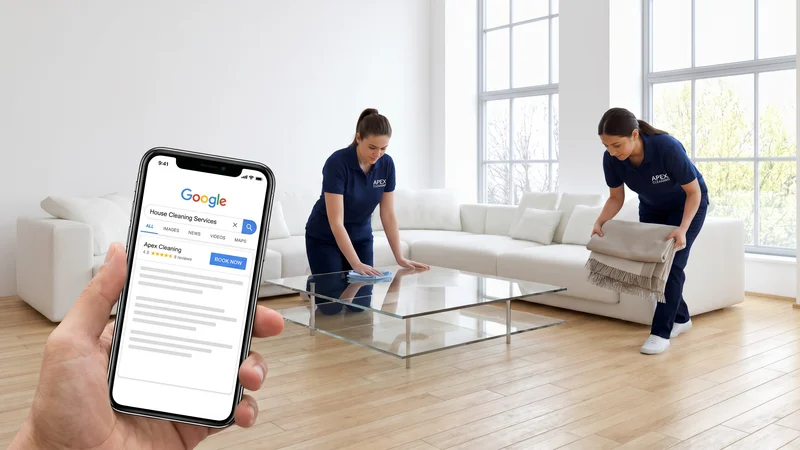
Most "Google Ads for cleaning companies" advice is written for the general house cleaning market: recurring weekly and biweekly visits, a fairly uniform service menu, and customers comparing three or four local providers on price. Maid services overlap with that market but are not identical to it. The mix of one-time deep cleans, move-out cleans tied to a lease deadline, add-on services like laundry or organizing, and a heavier reliance on trust signals (bonded, insured, background-checked staff) changes what should actually happen inside the account.
If you're ready to hand this off rather than build it yourself, that's exactly what our Cleaning & Maid Services PPC management is for. What follows is the strategy behind it, for anyone who wants to understand how a maid service account should be built before deciding whether to run it in-house or hand it off.
Why Maid Service Marketing Needs a Different Approach Than General Cleaning
General house cleaning campaigns are usually optimized around one goal: fill a recurring cleaning schedule at the lowest cost per booked visit. Maid services often carry a wider spread of job types in the same account, and each type has a different value and a different buyer.
- Recurring maid service (weekly, biweekly, monthly): highest lifetime value, worth the highest cost per lead.
- One-time deep clean: lower lifetime value but often the entry point that converts into a recurring client later.
- Move-in / move-out clean: time-sensitive, price-comparison-heavy, and frequently tied to a landlord's deposit deadline rather than the tenant's ongoing preference.
- Post-construction or specialty clean: rare but high-ticket, worth a separate ad group even at low volume.
Treating all four as one undifferentiated "cleaning lead" in the account means the recurring-client searches, which deserve your highest bids, get diluted by move-out searches that will never rebook. Splitting them into distinct campaigns or ad groups, each with its own target cost per lead, is the single biggest structural difference between a maid service account and a generic cleaning account.
Maid Service Marketing: Google Ads Search Campaigns vs Local Services Ads
Two Google products compete for the same maid service budget, and they solve different problems. Local Services Ads vs Google Search Ads covers the general tradeoff in depth; here's how it plays out specifically for maid services.
| Factor | Local Services Ads | Google Ads Search |
|---|---|---|
| Pricing model | Pay per lead (call or message) | Pay per click |
| Best for | Recurring, price-sensitive local searches | Higher-intent, higher-ticket, and one-time jobs |
| Trust signals | Google Guarantee badge, reviews front and center | Depends entirely on your landing page and ad copy |
| Control over messaging | Minimal, mostly business profile data | Full control of headlines, offers, and targeting |
| Typical use | Fill the recurring schedule | Sell higher-ticket deep cleans and move-out jobs |
In practice, most maid services that scale past a single crew run both. Local Services Ads tends to be the more efficient channel for filling recurring routes because of the Google Guarantee badge and the pay-per-lead model, which caps downside on bad calls. Search campaigns earn their keep on the higher-value, higher-consideration jobs, where a well-written landing page and a specific offer can outperform a generic profile listing.
Building the Campaign Structure
A maid service account that has outgrown "one campaign, one ad group" usually looks something like this:
- Campaign 1: Recurring Maid Service: ad groups split by frequency intent (weekly, biweekly) and by neighborhood or service area if the market is large enough to support it.
- Campaign 2: Deep Clean / One-Time: messaging built around a specific price anchor or first-clean offer, since these searchers are comparing options actively.
- Campaign 3: Move-In / Move-Out: tightly geo-targeted, time-of-day adjusted toward when renters actually search (evenings and weekends spike heavily), with copy that speaks to deposit-return guarantees if you offer them.
- Campaign 4 (optional): Branded: defensive campaign on your own business name, cheap to run and protects against competitors bidding on your brand.
Geography matters more here than in most verticals. A maid service's real service radius is usually 15-25 minutes of drive time from where the cleaning staff are based, not an entire metro area. Overly broad geo targeting is one of the most common sources of wasted spend we see when auditing accounts in this niche: leads come in from areas the business can't actually service, and every one of them is a wasted call.
Keyword Strategy Beyond "House Cleaning"
Generic terms like "house cleaning service" and "cleaning company near me" are covered well in our broader Google Ads for House Cleaning guide. Maid services specifically should build keyword coverage around:
- Service-type modifiers: "maid service," "housekeeping service," "recurring house cleaning," which tend to signal a buyer looking for an ongoing relationship rather than a single visit.
- Frequency modifiers: "weekly maid service," "biweekly cleaning service," which let you route directly to a page built for that exact frequency and its pricing.
- Situational modifiers: "move out cleaning," "post construction cleaning," "deep clean before guests," each with its own urgency and its own conversion message.
- Trust modifiers: "bonded and insured maid service," "background checked house cleaners," which matter more in this category than almost any other home service because customers are giving staff a house key or alarm code.
On the negative keyword side, "maid service" pulls a surprising amount of noise from job seekers ("maid service jobs," "how to become a maid," "maid service hiring") and from people looking for cleaning supplies rather than a cleaning service. Building that negative list before launch, not after the first month's spend, saves real money.
Ad Copy and Trust Signals That Convert
Because maid services involve someone entering a client's home, often unsupervised, trust copy converts better than price copy alone. The ads and landing pages that perform best in this category typically lead with:
- Bonded, insured, and background-checked staff, stated explicitly rather than implied
- A specific guarantee (re-clean guarantee, satisfaction guarantee) rather than a vague "quality service" claim
- Real review counts and rating, not just a star icon
- Clear pricing anchors or a fast quote mechanism, since "how much does a maid cost" is one of the first questions every visitor has
Landing Pages and the Booking Flow
A generic "Contact Us" page loses maid service leads that a dedicated booking flow would have captured. What tends to work best:
- An instant quote calculator based on home size and frequency, even a rough one, reduces the friction of "I don't know what this costs" before the visitor ever picks up the phone.
- Separate landing pages for recurring service, deep clean, and move-out clean, each matched to the campaign that sent the click, with the specific keyword's intent reflected in the headline.
- Visible trust badges (bonding, insurance, background checks) above the fold, not buried in an About page.
- A clear call button on mobile, since a large share of same-day and move-out searches happen on a phone.
Landing page speed and clarity compound with everything upstream. See our broader guide on call tracking for local services for how to actually attribute which campaign and keyword produced a booked job, not just a click, which matters even more here given how much of the funnel ends in a phone call rather than a form.
Budget, Bidding, and Measuring Lifetime Value
The mistake we see most often in maid service accounts is bidding toward cost per lead as if every lead were worth the same amount. A recurring biweekly client booked through a deep-clean campaign might be worth many times the value of a single move-out job, and Smart Bidding strategies work far better when they're given that signal.
Practical steps that make a real difference:
- Import offline conversion values (recurring client signed vs one-time job) back into Google Ads so bidding strategies optimize toward value, not just volume.
- Set separate target cost-per-acquisition goals for the recurring campaign and the one-time/move-out campaigns rather than one blended target for the account.
- Track the full first 90 days of a "won" lead, since a portion of one-time deep clean customers convert into recurring clients later, and that delayed value should feed back into which campaigns get more budget.
Typical customer acquisition costs vary a lot by market density and competition, so treat any published benchmark as a starting range rather than a target: many maid services see a meaningfully lower cost per acquisition on recurring-intent keywords than on one-time job keywords, simply because the lifetime value tolerance is so much higher.
From Raw Leads to Sales Qualified Leads
A phone call or form fill is a raw lead, not yet a customer. In maid service accounts, the gap between the two is wider than most owners expect: some callers are outside the service area, some want a one-time job when the business only wants recurring clients that week, and some are price-shopping four competitors at once and will book whoever answers first. Treating every raw lead as equally valuable is how a campaign that looks efficient on paper still leaves the schedule half full.
A simple qualification step, whether that's a receptionist, a booking coordinator, or a short intake form, filters raw leads down to Sales Qualified Leads: contacts who are in the service area, want a service the business actually offers, and are ready to book within a reasonable window. Feeding the outcome of that qualification back into Google Ads (as an offline conversion import, or at minimum as a manual review of which keywords produced Sales Qualified Leads versus dead-end calls) is one of the highest-leverage things a growing maid service can do, because it lets Smart Bidding optimize toward the leads that actually convert to revenue instead of toward call volume alone.
In practice this means pairing call tracking with a short qualification script the booking team can run in under a minute: service area, service type, and timeline. Keywords and campaigns that produce a high share of Sales Qualified Leads earn more budget; the ones that don't get trimmed or renegotiated on bid, regardless of how cheap the raw lead looked at first glance.
Common Mistakes Maid Service Owners Make with Google Ads
- Running one undifferentiated campaign for recurring, one-time, and move-out searches, which forces one bid and one message onto three different buyers.
- Geo targeting too broadly, generating leads outside the actual service radius that staff can reasonably reach.
- Skipping Local Services Ads entirely because Search feels more familiar, missing the pay-per-lead efficiency it often offers for recurring, price-comparison-driven searches.
- Not building a maid-specific negative keyword list, letting job-seeker and DIY-supply traffic burn budget.
- Optimizing to cost per lead instead of cost per booked (and ideally recurring) client, which rewards volume over the leads that actually turn into ongoing revenue.
None of these require a large budget to fix, they require the account to reflect how the business actually makes money: recurring relationships worth protecting, and one-time jobs worth acquiring efficiently but not overpaying for. For platform-level fundamentals that apply across any local service vertical, Google's own Google Ads Smart Bidding guide and the Local Services Ads help center are worth reviewing alongside whatever structure you build.